Behind the Cue - Pulse

Leslie Guerin • January 19, 2026

Why pulsing isn’t about speed—and why it’s becoming a mark of mastery in Pilates

“Pulse.”

If you’ve ever taken a barre class, the word probably feels familiar—maybe even expected. Pulse at the bottom of a squat. Pulse the heels higher. Pulse an inch up, an inch down. For years, pulsing lived comfortably in the barre world, often associated with high-repetition, small-range movements designed to fatigue a muscle.

But recently, the word pulse has been showing up more and more in Pilates classes—and not by accident.

This isn’t about borrowing language to stay trendy. It’s about refinement. Precision. And moving toward mastery rather than endurance for endurance’s sake.

Let’s talk about what pulsing actually is, what it is not, and why skilled teachers cue it intentionally.

Pulse Is Not a Filler

Let’s address the myth first.

Teachers do not ask you to pulse because they “ran out of ideas.”

If you’ve ever thought, “Oh, we’re pulsing because the teacher doesn’t know what else to do,” I want to gently—but clearly—dispel that.

A pulse is a deliberate choice.

It’s not a placeholder.
It’s not a shortcut.
And it’s certainly not mindless movement.

In fact, when pulsing is taught well, it requires more awareness, more control, and more intelligence than holding a position or moving through a full range of motion.

Pulse Does Not Mean Speed Up

Another common misunderstanding: pulsing does not mean moving faster.

This is where pulsing gets a bad reputation.

When pulses turn into bouncing, jerking, or momentum-driven movement, we lose the very thing the pulse is meant to cultivate: control.

A true pulse is:

  • Small
  • Measured
  • Intentional
  • Continuous

There is no bounce.
No shearing through joints.
No collapsing into end ranges.

Instead, the movement lives in a narrow range where the muscle stays under constant load.

Think less “faster” and more “deeper.”

A Shared Language Across Disciplines

While “pulse” is the word most commonly used in barre, the concept itself is not exclusive to barre at all.

In other rehabilitative and movement-based disciplines, you might hear terms like:

  • Threading
  • Kneading
  • Micro-movement
  • Oscillation

Different words, same intention.

Each describes a small, controlled movement designed to:

  • Maintain muscular engagement
  • Avoid gripping or bracing unnecessarily
  • Encourage circulation and neuromuscular feedback

Pilates has always been about precision and efficiency. As the method continues to evolve, it makes sense that language evolves too.

Pulse is simply a word that captures something Pilates has always valued—sustained, intelligent work.

Why Not Just Hold the Position?

This is where pulsing becomes truly interesting.

A static hold sounds like the ultimate test of strength. And sometimes, it is. But more often than not, a long hold leads to compensation.

When the body is asked to hold still for too long, it tends to:

  • Grip in places it shouldn’t
  • Lock joints instead of supporting them
  • Over-recruit stabilizers at the expense of prime movers

You might feel strong—but you may also be clenching your jaw, bracing your ribs, or tightening your hip flexors when they’re not meant to be leading the work.

A pulse interrupts that gripping pattern.

By introducing a small, controlled movement, the body is asked to adapt continuously. The prime mover stays active, but the ancillary muscles must respond moment by moment rather than lock into a single strategy.

This is not easier.
It’s smarter.

Prime Movers and Supporting Cast

Let’s get specific.

In a pulse:

  • The prime mover (the muscle intended to do the work) remains under sustained tension
  • The supporting muscles are constantly adjusting to maintain alignment and control

Nothing gets to “check out.”

This is why pulsing often feels more demanding than a full range movement—even though it looks smaller.

The work is happening internally.

And that internal work is what leads to mastery.

Pulse as a Tool for Learning, Not Just Burning

In less skilled environments, pulsing can become about fatigue alone: Do it until it burns.

But in thoughtful Pilates and barre-inspired programming, pulsing is a teaching tool.

It helps clients:

  • Locate the correct muscle group
  • Refine alignment in real time
  • Notice when compensation creeps in
  • Build endurance without sacrificing form

A well-placed pulse invites curiosity:
Where am I working right now?
What changed when the movement got smaller?
Can I stay present instead of pushing through?

These questions are the foundation of intelligent movement practice.

Why Pulse Is Entering Pilates Spaces

Pilates teachers are increasingly incorporating pulse because:

  • Clients are more educated and body-aware
  • Longevity matters more than extremes
  • Precision is valued over performance

Pulse allows for challenge without aggression.

It creates intensity without forcing range.
Strength without rigidity.
Effort without strain.

For populations dealing with injury history, joint sensitivity, or movement anxiety, pulsing offers a way to stay deeply engaged while remaining safe and supported.

Pulse and the Path Toward Mastery

Mastery isn’t about doing more.

It’s about doing better.

A pulse demands:

  • Attention
  • Patience
  • Willingness to stay with subtlety

You can’t rush through it.
You can’t fake it.
And you can’t rely on momentum.

That’s why pulsing often appears in advanced teaching—not because it’s flashy, but because it reveals what’s really happening beneath the surface.

What to Listen for as a Client

Next time a teacher cues “pulse,” listen closely to how it’s framed.

You might hear:

  • “Stay heavy in the spring.”
  • “Nothing changes above the ribs.”
  • “It’s not about how small—it's about how controlled.”
  • “Let the movement teach you.”

These cues tell you the pulse has intention.

And when it’s done well, you’ll leave feeling worked, aware, and more connected to your body—not just tired.

Behind the Cue

So the next time you hear the word pulse, know this:

It’s not a throwaway.
It’s not about speed.
And it’s not there to torture you.

It’s there to refine your movement, challenge your awareness, and guide you toward mastery—one small, intentional movement at a time.


By Leslie Guerin February 2, 2026
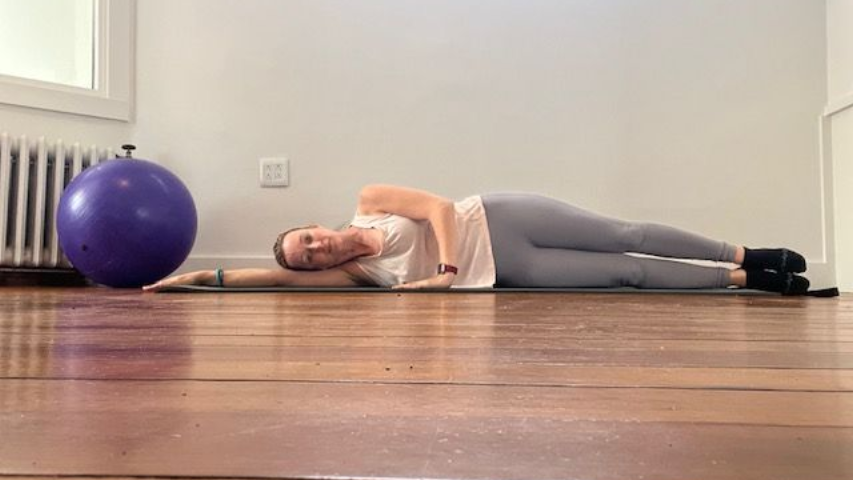
Stability Is Not Stillness — It’s Organized Effort “Hold still.” If you’ve ever taken one of my classes, you’ve heard me say it. And if you’ve ever felt it, you know it isn’t about freezing. Most of the time when a teacher says “hold still,” it’s because something else is happening. Maybe bouncing, gripping, bracing, or compensating of some kind. Something is moving that shouldn’t be. But “hold still” does not mean “be still.” Those two cues might sound similar, but in Pilates they mean very different things. Be Still vs Hold Still Be still is a pause. It’s a full stop. It’s often used so you can feel one specific thing: “Be still… feel your ribs.” “Be still… notice your pelvis.” “Be still… now breathe.” It’s about attention. Hold still is something else entirely. Hold still means: Stay organized Stay lifted Stay connected Stay breathing You are not passive. You are not collapsed. You are actively maintaining shape while something else moves. It is one of the most advanced skills in Pilates. Why Teachers Say “Hold Still” We say it when we see: The pelvis shifting The ribs popping The shoulders helping Momentum sneaking in The body is trying to get the job done by recruiting the wrong helpers. So “hold still” is really a request for clean movement : Let only the part that is supposed to move… move. Everything else must work just as hard, just not by changing position. Side-Lying Leg Lifts: The Perfect Example Let’s take one of the most deceptively simple exercises in mat Pilates: Side-lying leg lifts. On the surface, it looks like this: You lie on your side You lift the top leg You lower it But what is really happening is far more complex. This exercise is designed to balance one side of the body on the other . The top leg moves. The rest of the body holds still. Not rigid. Not collapsed. Not gripping. Holding. What “Hold Still” Actually Means Here While the top leg lifts and lowers: The bottom side of the body is working. The bottom rib cage is lifted off the mat, creating space The waist is long, not sagging The spine is stacked, not rolled back The top hand in front of the body is not there to lean on, it is there to quiet the rocking forward and backward. The pelvis stays level. No tipping. No hiking. No rolling. Everything that is not the leg is holding still... but nothing is relaxed. This Is Why Breathing Matters If you stop breathing, you are not holding still. You are bracing. Holding still means you can: Maintain the shape Keep the effort And still let the breath move That’s where the deep stabilizers do their job: The abdominals The muscles along the spine The lateral hip The inner thighs The breath becomes the test: Can you stay organized even while something else is moving? That’s real control. Why This Cue Changes Everything “Hold still” teaches the nervous system something incredibly important: You don’t create strength by moving more. You create strength by controlling what doesn’t move . That’s how: Hips become more stable Backs become more supported Movement becomes quieter and more powerful It’s also how injuries are prevented, especially in people who are flexible, mobile, or used to muscling through. So Next Time You Hear It… When I say “hold still,” I’m not asking you to freeze. I’m asking you to: Stay lifted Stay connected Stay breathing Stay honest Let the right thing move. Let everything else do its job. That’s Pilates.
By Leslie Guerin January 30, 2026
Small, regular efforts add up
By Leslie Guerin January 29, 2026
The Manual I Wish I Had When I Started Teaching Pilates
By Leslie Guerin January 28, 2026
A Thoughtful Approach to Barre, Mat Pilates, and Reformer Progression in the Modern Studio
By Leslie Guerin January 27, 2026
In Every Movement
By Leslie Guerin January 26, 2026
(And What to Say Instead)
By Leslie Guerin January 23, 2026
Why I Built a One-to-One, Self-Paced Teacher Training Model
By Leslie Guerin January 22, 2026
On music, Pilates, and the strange urge to prove you were there first
By Leslie Guerin January 21, 2026
More Than Just Neck Comfort
By Leslie Guerin January 20, 2026
Why Moving Through the Work Can Be Just as Meditative as Holding Still
Show More